- Cisco Community
- Technology and Support
- Networking
- Routing
- Route Reflector over MPLS VPN
- Subscribe to RSS Feed
- Mark Topic as New
- Mark Topic as Read
- Float this Topic for Current User
- Bookmark
- Subscribe
- Mute
- Printer Friendly Page


- Mark as New
- Bookmark
- Subscribe
- Mute
- Subscribe to RSS Feed
- Permalink
- Report Inappropriate Content
03-07-2014 05:20 PM - edited 03-04-2019 10:32 PM
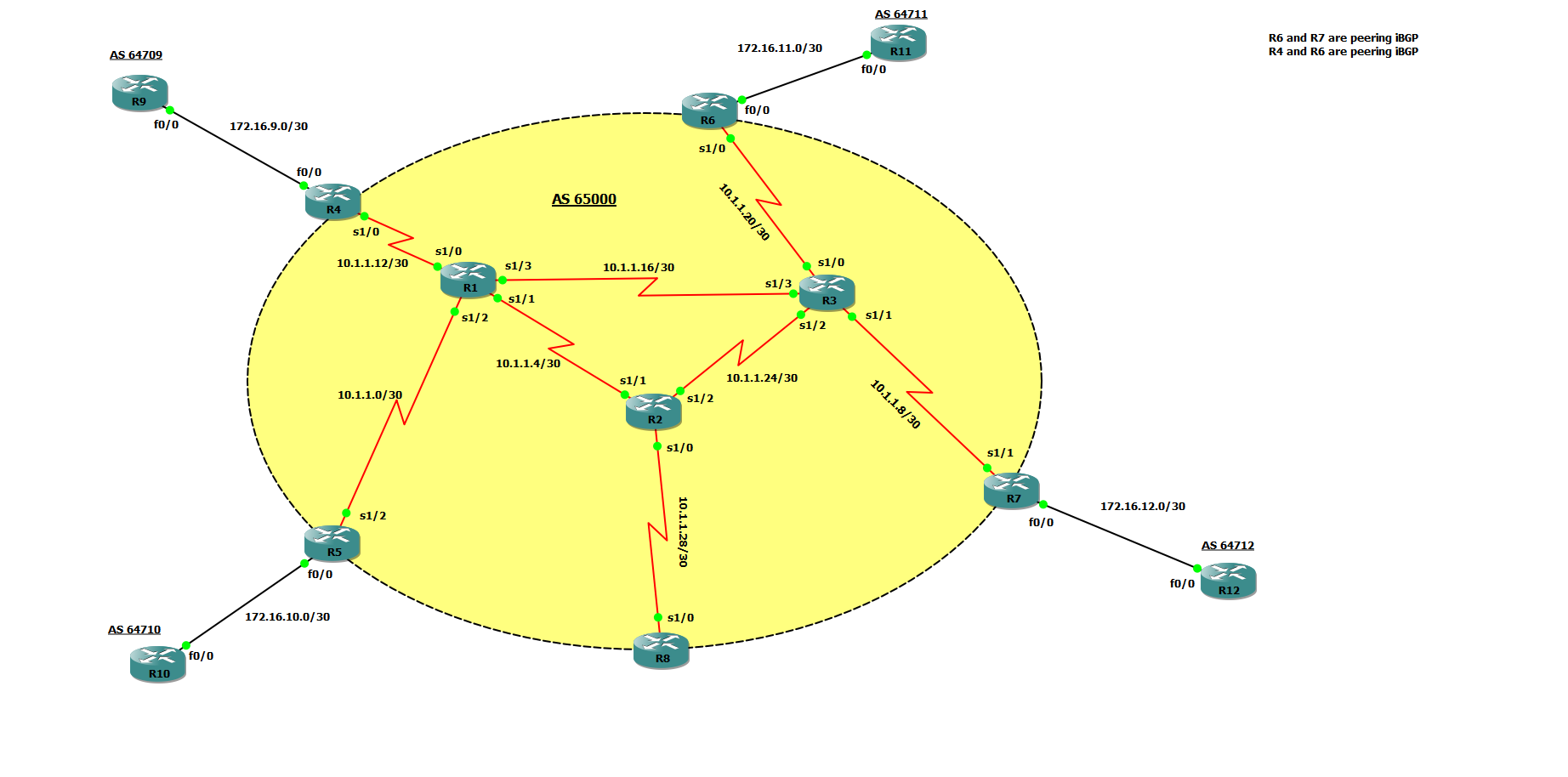
I have R4 peering iBGP with R6, and I have R6 peering iBGP with R7.
Now these routers are peering eBGP with their connected routers over ethernet.
So I have few things I may know but cant seem to put them to work in this lab. I want all the BGP routers that do not belong to AS65000 to be able to know about each others networks. Currently they do not and I think it is because the routers peering iBGP in AS 65000 are prevented from learning each others networks due to split horizon. So Route reflectors are needed, but I dont understand where the reflector should be since the core of the network is not running BGP.
Solved! Go to Solution.
- Labels:
-
Other Routing
Accepted Solutions

- Mark as New
- Bookmark
- Subscribe
- Mute
- Subscribe to RSS Feed
- Permalink
- Report Inappropriate Content
03-10-2014 11:11 AM
Okey,
Now the question is clear :D
Here is where I think you got confused.
So first of all we agree on the fact that while using R7 as router reflector the routers from R6 will be advertised to R4 and backwards, right?
Now to the MPLS Topic:
The advantage of running MPLS , Actually one of the advantages is the capability of run what is known as a Free BGP Core.
Let me take advantage of this answer and invite you to my personal blog and ask you to read this specific entry:
http://www.laguiadelnetworking.com/mpls-the-fundamentals-part-i-faster-forwarding-bgp-free-core/
As you will see the advantage is that MPLS P routers only need to know how to reach the PE routers in order to route traffic to the different customer networks without the requirement of learning each customer IP address on their site (Imagine having to do that, wow).
How cool is that right?? That's known as the Free BGP Core Feature of MPLS.
Last but not least remember to rate all of my helpful posts
Regards,
Jcarvaja
Senior Network Security and Core Specialist
CCIE #42930, 2xCCNP, JNCIP-SEC
- Mark as New
- Bookmark
- Subscribe
- Mute
- Subscribe to RSS Feed
- Permalink
- Report Inappropriate Content
03-10-2014 06:02 AM
Hello,
So you telling us inside AS 6500 you are not running BGP??
Of first of all the Loop Prevention rule from BGP says that you will not advertise iBGP routes to an iBGP neighbor but in this case you are learning eBGP routes so those should actually be advertised between each other.
So on R6 if you do
show ip bgp nei x.x.x.x (R4 IP) advertised-routes what do u see?
Run same command on R4
If you see the routes being advertised to each other then do
show ip bgp x.x.x.x/Y where Y is the netmask in order to see why is not being installed (as you said that the problem is not getting them to see the routes)
Regards,
Senior Network Security and Core Specialist
CCIE #42930, 2xCCNP, JNCIP-SEC
- Mark as New
- Bookmark
- Subscribe
- Mute
- Subscribe to RSS Feed
- Permalink
- Report Inappropriate Content
03-10-2014 10:07 AM
Ok I reconfigured this late last night to make sure it wasnt a GNS3 bug. So same thing except that both R4 and R6 iBGP peer with R7 only, not each other. So I understand the split horizon rule thus the reason for configuring R7 as a route-reflector. Also on R9, R11, and R12 I am redistributing connected in BGP. So thats advertising loopback networks to the PE's (R4, R6, R7). So I have that going. What I am stuck on is how do the PE's get those routes into the core ISIS routers (R1, R2, R3) so they know where to switch those packets too? I cant imagine ISPs are redistributing BGP into ISIS. I have mpls ip configured on all routers in the core including the PE's.
Ok so on R6 it says I am not advertising anything to R7. This makes sense as I am not using a network command in BGP, but before I tried to also use redistribute connected on the PE's and that didnt work either.
- Mark as New
- Bookmark
- Subscribe
- Mute
- Subscribe to RSS Feed
- Permalink
- Report Inappropriate Content
03-10-2014 11:11 AM
Okey,
Now the question is clear :D
Here is where I think you got confused.
So first of all we agree on the fact that while using R7 as router reflector the routers from R6 will be advertised to R4 and backwards, right?
Now to the MPLS Topic:
The advantage of running MPLS , Actually one of the advantages is the capability of run what is known as a Free BGP Core.
Let me take advantage of this answer and invite you to my personal blog and ask you to read this specific entry:
http://www.laguiadelnetworking.com/mpls-the-fundamentals-part-i-faster-forwarding-bgp-free-core/
As you will see the advantage is that MPLS P routers only need to know how to reach the PE routers in order to route traffic to the different customer networks without the requirement of learning each customer IP address on their site (Imagine having to do that, wow).
How cool is that right?? That's known as the Free BGP Core Feature of MPLS.
Last but not least remember to rate all of my helpful posts
Regards,
Jcarvaja
Senior Network Security and Core Specialist
CCIE #42930, 2xCCNP, JNCIP-SEC
- Mark as New
- Bookmark
- Subscribe
- Mute
- Subscribe to RSS Feed
- Permalink
- Report Inappropriate Content
03-10-2014 11:18 AM
So now when I use the network commands on the PE's I can get from CE connected to R4 all the way to CE connected to R6...BUT...and I forgot this...when I source the trace or the ping.
Now next question/confusion. BGP free core, yes I hear this on articles and makes perfect sense. But lets say I am a customer and I manage R9 connected to PE R4...PE is owned and managed by ISP, I cannot access it. Now I create another network from R9 and it advertises to R4 because of "redistribute connected" unless the ISP uses the network command on the PE my new network will never be reachable to my other site routers...How can we get around this?
- Mark as New
- Bookmark
- Subscribe
- Mute
- Subscribe to RSS Feed
- Permalink
- Report Inappropriate Content
03-10-2014 02:16 PM
Hello,
That is not true,
As long as the ISP is aware of the route any of your MPLS Sites will be able to reach it.
You dont need to go and manually set the network command in the BGP process, instead you advertise that prefix to the BGP router.
It learns it via one of the vpnv4 address family so it advertises to the right vpvn4 neighbor till it reaches the other site PE router and then gets redistributed to the IGP or even VRF BGP routing table.
The whole purpose of this BGP Free Core technology or even one of the greatest advantages of MPLS vpn over other technologies is the fact that the P routers do not have to carry those customer routes in their routing table. They just need how to reach each of the PEs and boom you are done.
Regards,
Jcarvaja
Remember to rate all of the helpful posts
Senior Network Security and Core Specialist
CCIE #42930, 2xCCNP, JNCIP-SEC
- Mark as New
- Bookmark
- Subscribe
- Mute
- Subscribe to RSS Feed
- Permalink
- Report Inappropriate Content
03-10-2014 05:25 PM
So that might be a little out of my scope of knowledge at the moment. I am not using any vpnv4 configuration. I am just using the command "mpls ip" on serial interfaces in the core of the network. Once I get the hang of that, then I want to start working vpnv4 and VRF's.


- Mark as New
- Bookmark
- Subscribe
- Mute
- Subscribe to RSS Feed
- Permalink
- Report Inappropriate Content
03-10-2014 05:57 PM
Hi Steven
If you create a new network on a CE device and that network is advertised to the PE via BGP then the PE will automatically advertise it to the other PEs and they in turn will advertise it to their CEs (assuming they are using BGP to exchange routes with the CE).
This is one of the reasons some providers like customers to use BGP to peer with their PE devices because this makes the advertisement automatic.
If you used an IGP between the CE and PE then on the PE you would need to redistribute that IGP into BGP before the PE advertised it to any other PEs. And if the PEs that received the routes were also using an IGP to their CEs they would then need to redistribute BGP back into the IGP.
Note that none of this applies to the IGP you run internally within the MPLS network ie. there is no need to redistribute any external customer routes into the internal IGP.
Jon
- Mark as New
- Bookmark
- Subscribe
- Mute
- Subscribe to RSS Feed
- Permalink
- Report Inappropriate Content
03-11-2014 05:00 PM
Alright so this makes sense now...I figured the ISP didnt want to bothered every time, I, as a customer would create another network.
Now I am getting around the iBGP split horizon rule using RR, but I read that this is not a recommended solution. Is this true? The correct way is stated as BGP confederations. I thought that was an old way to do it. What are we seeing inside the core of the MPLS network being used? I really wish I could see the config on my ISP's PE to see what they are doing to please my curiousity.
- Mark as New
- Bookmark
- Subscribe
- Mute
- Subscribe to RSS Feed
- Permalink
- Report Inappropriate Content
03-15-2014 10:18 PM
Glad to see that we could help,
Please remember to rate all of the helpful posts and mark the question as answered.
In regards to your last question both of the situations are going to help you. I think Route-Reflection is a valid option and it's the easist to configure. Route-Reflectors use the BGP Cluster-ID value in order to prevent any possible loops so I do not see how can affect.
Regards,
Senior Network Security and Core Specialist
CCIE #42930, 2xCCNP, JNCIP-SEC
- Mark as New
- Bookmark
- Subscribe
- Mute
- Subscribe to RSS Feed
- Permalink
- Report Inappropriate Content
03-10-2014 08:28 PM
Senior Network Security and Core Specialist
CCIE #42930, 2xCCNP, JNCIP-SEC

Discover and save your favorite ideas. Come back to expert answers, step-by-step guides, recent topics, and more.
New here? Get started with these tips. How to use Community New member guide