- Cisco Community
- Technology and Support
- Networking
- Switching
- Cable Diagnostics test
- Subscribe to RSS Feed
- Mark Topic as New
- Mark Topic as Read
- Float this Topic for Current User
- Bookmark
- Subscribe
- Mute
- Printer Friendly Page
Cable Diagnostics test


- Mark as New
- Bookmark
- Subscribe
- Mute
- Subscribe to RSS Feed
- Permalink
- Report Inappropriate Content
12-13-2024 10:41 AM
Hello,
Our team is having an internal discussion regarding the Cable diagnostics test "test cable-diagnostics tdr interface xxx" command and if POE should be turned off when running the test. One group believes that if the end device requires POE, you leave it on when testing and if its not a POE device, turn it off before testing, then reenabling after test is complete.
Thoughts?
- Labels:
-
Catalyst 3000


- Mark as New
- Bookmark
- Subscribe
- Mute
- Subscribe to RSS Feed
- Permalink
- Report Inappropriate Content
12-13-2024 11:53 AM
Who won?
- Mark as New
- Bookmark
- Subscribe
- Mute
- Subscribe to RSS Feed
- Permalink
- Report Inappropriate Content
12-13-2024 11:59 AM
Thats why I posted this, to see if it mattered. Who won has yet to be established.


- Mark as New
- Bookmark
- Subscribe
- Mute
- Subscribe to RSS Feed
- Permalink
- Report Inappropriate Content
12-13-2024 03:43 PM - edited 12-13-2024 05:23 PM
Depends on the OS. If the OS is IOS-XE, depending on the firmware version.
Typically, TDR in classic IOS is fairly accurate. In IOS-XE if the firmware is 3.X.X, the TDR result is also accurate. However, if the IOS-XE version is 16.X.X and/or 17.X.X, the TDR result is not to be trusted because it is no longer accurate. See examples below:

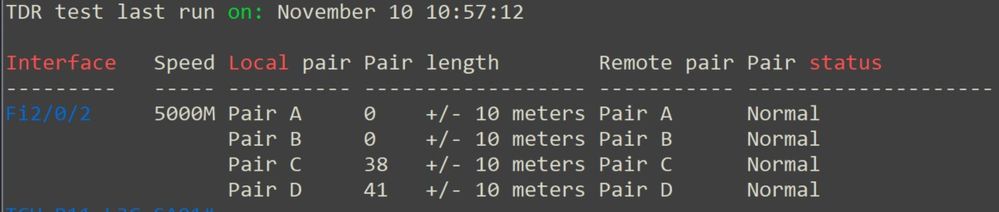


Because all of our IOS-XE switches are PoE, we found out that turning off PoE (power inline never) first and then launching the TDR test will yield a better result.
Currently, there are two Bug IDs: CSCvw97924 & CSCwd97177
Initially, we were told that the bug is due to the Broadcom chip. From another Cisco staffer, CSCvw97924 & CSCwd97177 will never be fixed and blaming Broadcom is just a way to divert everyone's attention. Why blame Broadcom when it was working if the switch is on 3.X.X?

Discover and save your favorite ideas. Come back to expert answers, step-by-step guides, recent topics, and more.
New here? Get started with these tips. How to use Community New member guide