- Cisco Community
- Technology and Support
- Service Providers
- MPLS
- Re: Calling Segment Routing experts
- Subscribe to RSS Feed
- Mark Topic as New
- Mark Topic as Read
- Float this Topic for Current User
- Bookmark
- Subscribe
- Mute
- Printer Friendly Page


- Mark as New
- Bookmark
- Subscribe
- Mute
- Subscribe to RSS Feed
- Permalink
- Report Inappropriate Content
06-01-2019 05:55 AM - edited 06-01-2019 10:03 AM
Good afternoon everyone. I have a very simple question regarding SR TE using dynamic dynamic candidate path. I am reading C.Filsfils' "Segment Routing Part II" book, in which there is this example:
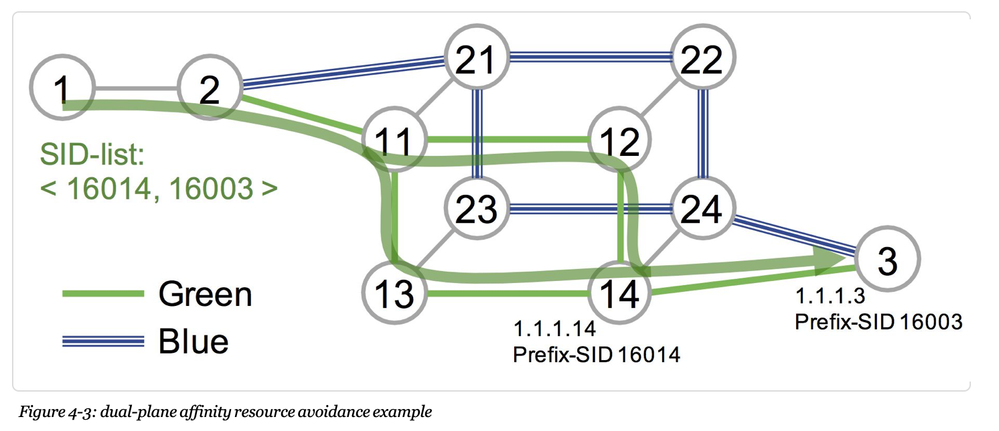
The example given in the book basically has constrain configured on R1 to avoid the GREEN path and that's okay.
Now I have a use case, where my topology is slightly more complicated, but let's say for example, that I have a specific requirement to use the link between routers 23 and 24. Let's say we give this link a color "purple".
Is it possible, following the example topology above, to simply define an alternative logic (e.g. not using exclude-any, but rather using include-any) doing something like this (I don't care if I will go via GREEN or BLUE path in this particular case. All I want to do is the policy to establish a path using the link between 23 and 24😞
policy 1-to-3
 color 1 end-point ipv4 1.1.1.3
!
   candidate-paths
    preference 10
     dynamic
      metric
       type igp
      !
     !
     constraints
      affinity
       include-any
        purple
is this supposed to work or not? My thinking is that the SR should simply follow best-path to Router 23 then using either prefix sid for 24 or an adjacency sid to get across that particular link. Is “include-any” an implicit method where the path is built based on any of the specified colours only and therefore that won’t work as there isn’t a purple link available from 1 to 23? I am aware of other methods I can use but I am wondering if I can simply give a link in the network a color and then simply define a policy saying "use this link"?
Hope that makes sense and thanks in advance for your time.
Solved! Go to Solution.
- Labels:
-
MPLS
Accepted Solutions


- Mark as New
- Bookmark
- Subscribe
- Mute
- Subscribe to RSS Feed
- Permalink
- Report Inappropriate Content
06-01-2019 08:47 PM
Hi Daniel,
> is this supposed to work or not?
No, it won't. As you mentioned, the remaining links are not colored with purple.
Regards,
Harold Ritter, CCIE #4168 (EI, SP)
- Mark as New
- Bookmark
- Subscribe
- Mute
- Subscribe to RSS Feed
- Permalink
- Report Inappropriate Content
06-01-2019 08:47 PM
Hi Daniel,
> is this supposed to work or not?
No, it won't. As you mentioned, the remaining links are not colored with purple.
Regards,
Harold Ritter, CCIE #4168 (EI, SP)
- Mark as New
- Bookmark
- Subscribe
- Mute
- Subscribe to RSS Feed
- Permalink
- Report Inappropriate Content
06-02-2019 03:09 AM
Thanks very much Harold, that makes sense.
The whole reason I am asking this question is because I have a use case where I need to consider TE using SR, but I have a limitation of using more than 3 labels throughout the network.. This isn’t ideal especially considering the fact we must also provision VPWS as well as L3 VPNs using SR TE to steer the traffic... So I was wondering what’s the best approach (if possible at all) to do this across 6-7 devices, where the best path to the destination doesn’t necessarily follow the IGP. Adding TI LFA in the equation also doesn’t help, but this is something I am willing to accept as a short period of time during the IGP reconvergence.
Any hints or ideas as of tips & tricks I can try to reduce the label stack will be much appreciated.
Thanks,
Danny

- Mark as New
- Bookmark
- Subscribe
- Mute
- Subscribe to RSS Feed
- Permalink
- Report Inappropriate Content
06-02-2019 03:50 AM
or set of links/nodes) can be done easiest by using loose hop or hops with
your LSP.
The use of colours is tricky. There are basically only two options:
1) if you include a color it needs to be present on all links along the path
2) if you use exclude that's where you can single out a specific link to be
excluded

- Mark as New
- Bookmark
- Subscribe
- Mute
- Subscribe to RSS Feed
- Permalink
- Report Inappropriate Content
06-02-2019 03:46 AM
Just for completeness. What you want to accomplish (include a specific link or set of links/nodes) can be done easiest by using loose hop or hops with your LSP.
The use of colours is tricky. There are basically only two options:
1) if you include a color it needs to be present on all links along the path
2) if you use exclude that's where you can single out a specific link to be excluded

Discover and save your favorite ideas. Come back to expert answers, step-by-step guides, recent topics, and more.
New here? Get started with these tips. How to use Community New member guide